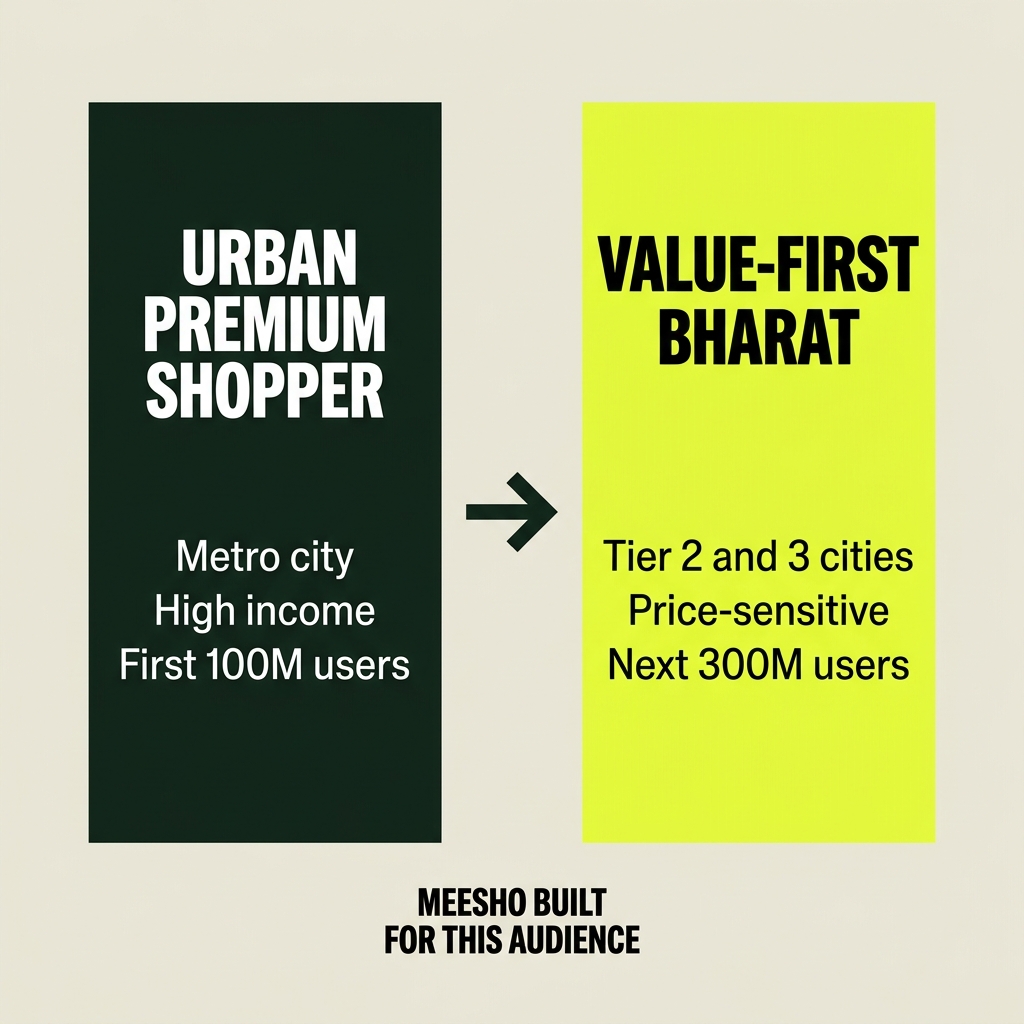
The audience Meesho chose
Meesho's app, pricing architecture and supply chain were designed for a customer that existing Indian e-commerce platforms were not optimising for in 2015-2019: a first-time internet user in a tier-2 or tier-3 city, shopping on an entry-level Android phone on a limited data plan, with a household income below the median for existing e-commerce buyers. This is not a characterisation from Meesho's marketing; it is a reconstruction from Meesho's DRHP (Draft Red Herring Prospectus) and investor interviews documented in the public record.
The initial go-to-market through WhatsApp resellers — women who sold Meesho products to their social networks without holding inventory — served a second audience simultaneously: low-income women who wanted to earn without a formal business. This dual audience design is structurally unusual among Indian e-commerce platforms and is the primary source of Meesho's early organic growth.
The brand strategy behind the price
Meesho's brand is built on a single, verifiable promise: the lowest price for a category of everyday product. Its zero-commission model for suppliers (introduced and then modified; current terms should be verified at Meesho's supplier portal) allowed it to undercut platform fees charged by Amazon and Flipkart to sellers, which could theoretically pass lower prices to buyers. This is the commercial mechanism behind the marketing claim.
The brand's advertising — most visible in vernacular-language campaigns on YouTube and regional TV — does not rely on premium production values or celebrity association to the same degree as Flipkart's or Amazon's festive advertising. The creative choice matches the audience: accessible, relatable, often humorous scenarios set in small-city households. The brand signal is 'this platform is for you' — a form of audience recognition that premium platforms find structurally difficult to replicate.
What the evidence does and does not show
Meesho's DRHP, Softbank investor communications and independently reported order-volume figures establish the scale of the platform's growth. They do not confirm profitability at the transaction level, the retention rate of reseller-acquired customers versus direct customers, or the long-term sustainability of zero-commission seller terms. These are open questions for investors and competitors, not settled facts.
The vernacular and social-commerce approach has been cited as a growth driver in media interviews with Meesho's leadership and in independent tech reporting. We treat those as directional evidence of strategy, not proof of causation.
A useful version for a smaller brand
Choose a customer who is systematically underserved by the existing market — not a customer who is merely a smaller version of the dominant customer. Design for that person's constraints first, then ask which of your current capabilities are a liability because they were built for someone else.
- Name the constraint your target customer has that the market leader ignores.
- Remove one product assumption that only makes sense for a premium buyer.
- Test whether your supply chain or delivery network can serve a smaller city at a margin that works.
A platform that defines its customer more narrowly than its competitors can be built more cheaply than one that tries to serve everyone.
Sources & notes
Source links document the campaign and reporting. Strategic interpretation is mkrting.com's own.
- Primary regulatory filingMeesho Draft Red Herring Prospectus (SEBI filing) ↗
- Primary product termsMeesho supplier and seller policy ↗
- Independent reportingInc42 analysis of Meesho's Bharat commerce strategy ↗
AI-assisted research and original mkrting.com analysis. Facts were checked against linked primary sources. The DRHP is the authoritative source for strategic intent and financial claims. Seller terms may have changed since filing; current terms should be verified at the supplier portal.
Found an error? Read our corrections policy.